Classical African Harp Project
A New Era for the African Harp: Academic Tone, European Luthier Craftsmanship, and Traditional Soul
1. Introduction & Project Concept
The African harp (kora) is an extraordinary instrument with a rich centuries-old tradition, revered for its mesmerizing, liquid acoustic voice. However, for generations, its construction has remained bound to traditional, rustic materials that impose severe structural and acoustic limitations on modern performers. This project was conceived 7 years ago out of a vision to break free from these historical constraints without sacrificing the soul, essence, or ergonomic intimacy of the instrument.
The Classical African Harp (Classical Kora / Classical Ngoni) represents the world’s first instrument designed to transition the traditional African harp into the realm of refined, chamber-style European musical instruments. By replacing raw, unpredictable materials with proven master-grade lutherie techniques—similar to those used in classical guitars, violins, and cellos—I have developed an instrument that meets the rigorous demands of concert halls, recording studios, and international touring.
Today, I stand at the threshold of a major technological breakthrough. Having mastered the foundational principles and unlocked a vast universe of modern manufacturing techniques, I am now diving deep into this new technological landscape. The core proof of concept is fully validated, establishing a rock-solid foundation for methodical, long-term R&D and continuous acoustic innovation.
2. Traditional Constraints vs. My Engineering Solution
The Limitations of Traditional Materials (Calabash & Rawhide):
Acoustic Muting & Energy Loss: The traditional resonator relies on a dried calabash gourd. While historically respected, pumpkin/gourd wood is soft, porous, and acoustically dead. Its internal surface actively dampens sound vibrations, failing to resonate or amplify the instrument's sound. It serves merely as a passive acoustic chamber rather than an active sound-producing body.
Extreme Environmental Instability: The traditional soundboard consists of wet-stretched calfskin rawhide. Rawhide is notoriously susceptible to changes in humidity and temperature. In humid environments, skin sags, loses tension, and turns the tone dull; in dry climates, it over-tightens, changes pitch unpredictably, or tears under the immense pressure of the strings. Controlling or predicting the final tension of dried skin during building is almost impossible.
Supply Chain & Quality Inconsistencies: Sourcing high-quality gourds and raw skins of consistent dimensions from Africa is increasingly difficult, unpredictable, and impossible to standardize for professional production.
My Engineering Solution:
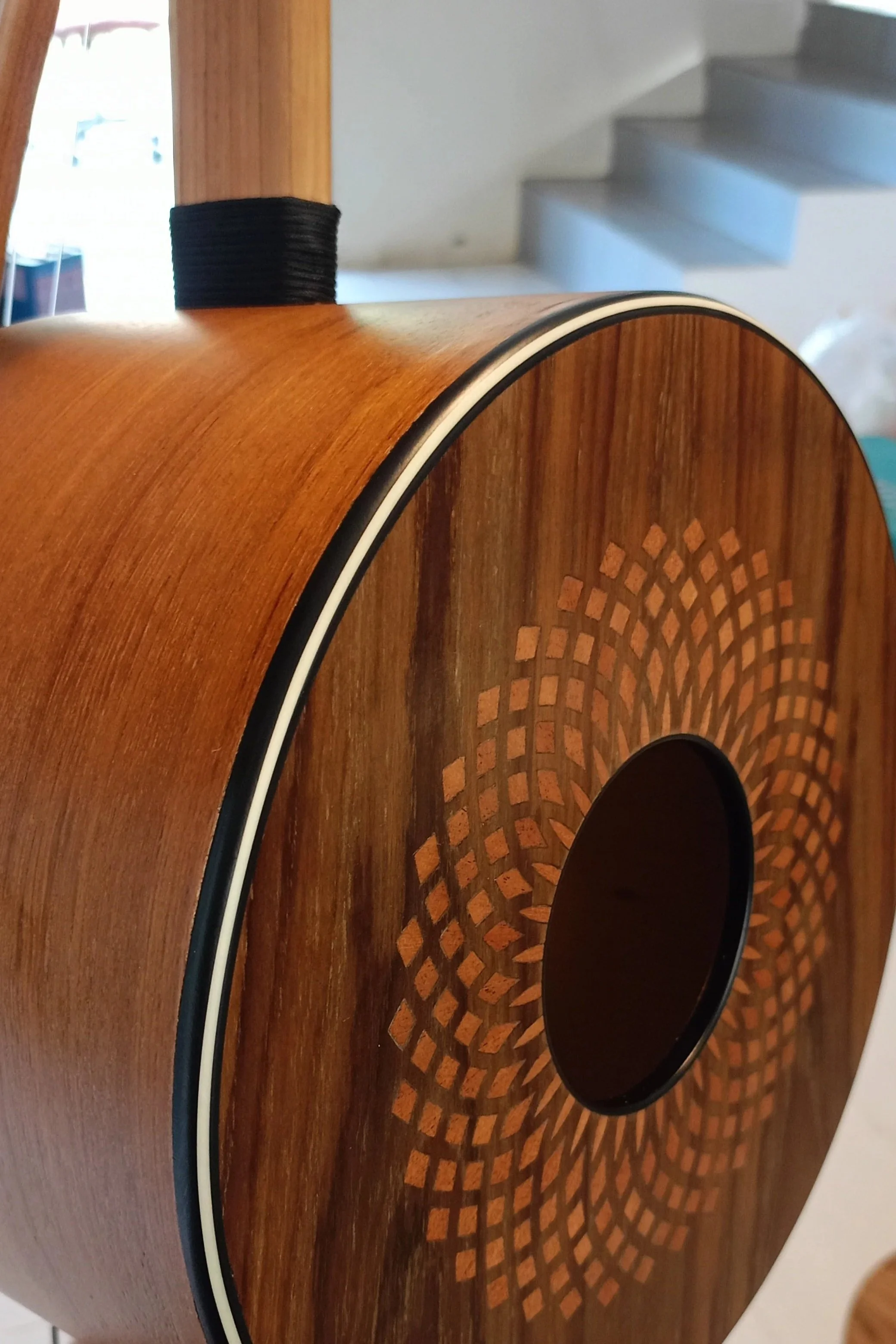
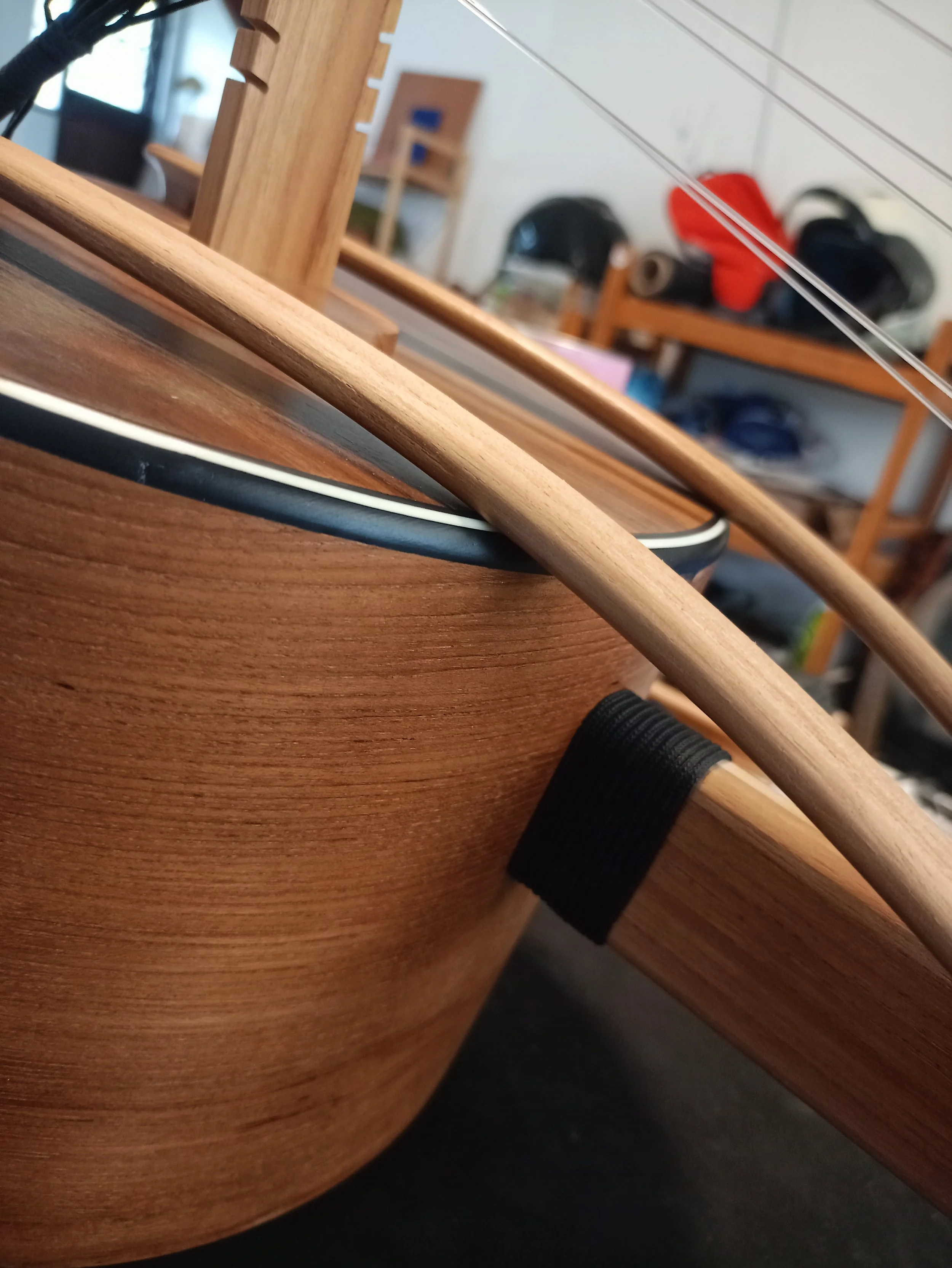
All-Wood Resonant Body (Guitar Lutherie Architecture): Replacing the gourd, the body is engineered from thin, flexible multi-layer plywood ribs wrapped in high-grade natural timber veneers. The body is constructed using rigid internal framework techniques similar to classical guitar building. Instead of dampening sound, both the top and back wooden soundboards actively vibrate and project energy, significantly enhancing projection and richness.
Engineered Multilayered Acoustic Soundboard: The rawhide membrane is replaced by an ultra-lightweight, high-strength soundboard made of high-quality multilayered birch plywood faced with precious wood veneers. Reinforced with a complex, mathematically calculated system of internal bracing (braces/springs), this soundboard easily withstands heavy string loads while converting maximum vibrational energy into pure sound without damping.
20–30% Increase in Volume, Brightness & Sustain: Physical prototype testing proves that even prior to meticulous acoustic fine-tuning, the wooden resonant body is 20% to 30% louder, brighter, and offers vastly superior sustain compared to traditional gourd-and-skin builds.
Complete Climate & Atmospheric Immunity: All timber components are fully sealed against air and moisture. The exterior is protected with high-durability gloss or satin lacquer, while internal cavities are treated with protective oils or lacquers. The instrument is completely immune to humidity shifts and retains its tuning stability anywhere in the world.